
Introduction
Basilica Cistern Istanbul stands beneath the historic peninsula as one of the greatest achievements of Byzantine engineering. In the 6th century, Emperor Justinian ordered workers to construct this vast underground reservoir to supply water to the Great Palace and nearby districts.
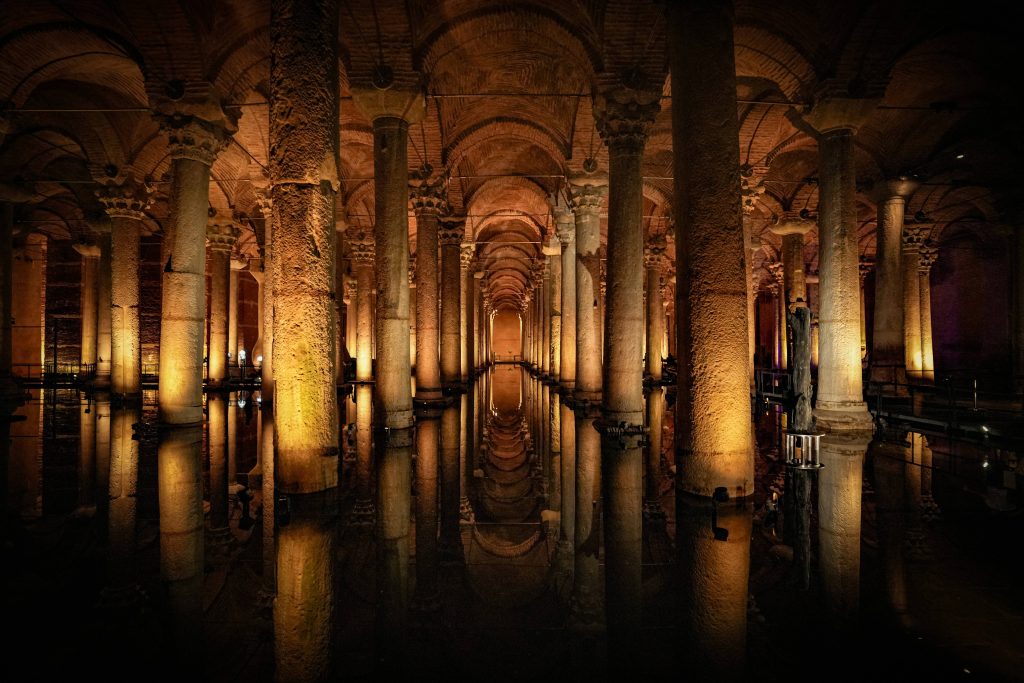
Today, visitors enter a cool and atmospheric space filled with 336 marble columns. Soft light reflects across the water and highlights the massive brick vaults above. At the southern corner, craftsmen positioned two Medusa heads beneath towering pillars, creating one of the most mysterious details inside Basilica Cistern Istanbul.
Moreover, the structure reveals how Constantinople managed water during sieges and periods of rapid population growth. Instead of relying on surface sources, engineers designed an advanced system that collected and stored water securely beneath the city.
For this reason, Basilica Cistern Istanbul represents more than an architectural monument. It demonstrates strategic planning, hydraulic knowledge and imperial power in the heart of Sultanahmet.

Why Was the Basilica Cistern Built?
In the 6th century, Constantinople was one of the largest cities in the world. A city of this scale required a stable and protected water supply.
After the Nika Revolt in 532 AD, Emperor Justinian launched massive reconstruction projects across the city — including Hagia Sophia and the Basilica Cistern.
The cistern was designed to:
Store fresh water
Supply the Great Palace
Provide water security during sieges
Water was transported from Belgrade Forest through aqueduct systems, including the famous Valens Aqueduct.
This was not just infrastructure. It was strategic survival planning.

Architectural Dimensions and Structure
The Basilica Cistern covers approximately 10,000 square meters and measures around 140 meters in length and 70 meters in width.
It once held nearly 80,000 tons of water.
Key architectural features include:
336 marble columns arranged in 12 rows
Each column approximately 9 meters high
Brick vault ceilings
Waterproof hydraulic mortar lining the walls
52 stone steps leading underground
The columns were not all built for this cistern. Many were reused from earlier Roman temples and buildings — a common Byzantine practice known as spolia.
This is why no two columns are exactly the same.
The Medusa Heads – Myth and Mystery
One of the most fascinating details of the Basilica Cistern is the two Medusa heads used as column bases in the northwest corner.
One head is placed sideways.
The other is placed upside down.
Why are they positioned this way?
There are two main interpretations:
Practical reuse – They were simply reused stones placed according to structural need.
Symbolic protection – In mythology, Medusa’s gaze turned people to stone. Placing her upside down may have been intended to neutralize her power.
No definitive historical record confirms either explanation.
But the mystery continues to attract millions of visitors.

The Atmosphere – Engineering Meets Experience
Unlike most ancient sites exposed to sunlight, the Basilica Cistern creates a completely different sensory experience.
Dim lighting reflects off shallow water pools.
Columns rise endlessly into shadow.
The sound of dripping water echoes softly.
This atmospheric design was not meant for tourists — yet it feels theatrical.
The structure also demonstrates advanced acoustic engineering. Sound travels cleanly through the space, which helped during maintenance and inspection.

Constantinople’s Water System
The Basilica Cistern was part of a much larger network of aqueducts and reservoirs.
Water was transported from sources dozens of kilometers away and distributed through a complex gravity-based system.
Without this infrastructure, Constantinople could not have survived:
Population growth
Long sieges
Seasonal droughts
The cistern represents the invisible backbone of the Byzantine capital.

Restoration and Modern Museum Identity
Over the centuries, the Basilica Cistern underwent several restorations.
In recent years, a major conservation project strengthened the structure and modernized the lighting and visitor experience.
Today, the site operates as a museum and remains one of the most visited landmarks in Istanbul.
Its location — just minutes from Hagia Sophia and the Blue Mosque — makes it part of the historical heart of the city.

Why Basilica Cistern Is More Than a Tourist Attraction
Many monuments show power.
Some show art.
A few show faith.
The Basilica Cistern shows survival.
It reveals how an ancient empire engineered resilience beneath the surface.
It is not simply an underground water tank.
It is the hidden foundation of Constantinople.

Visiting Basilica Cistern Today
Location: Sultanahmet, Istanbul
Open daily (check current hours before visiting)
Best time to visit: early morning or late afternoon to avoid crowds
Photography tip:
Wide-angle lenses capture the column symmetry beautifully, especially near the Medusa heads.

Final Thought
The Basilica Cistern reminds us that great cities are not only built above ground.
Sometimes their greatest achievements are hidden below.
When you visit, pause in silence.
Listen to the echoes.
Imagine the empire that depended on this underground palace of water.


