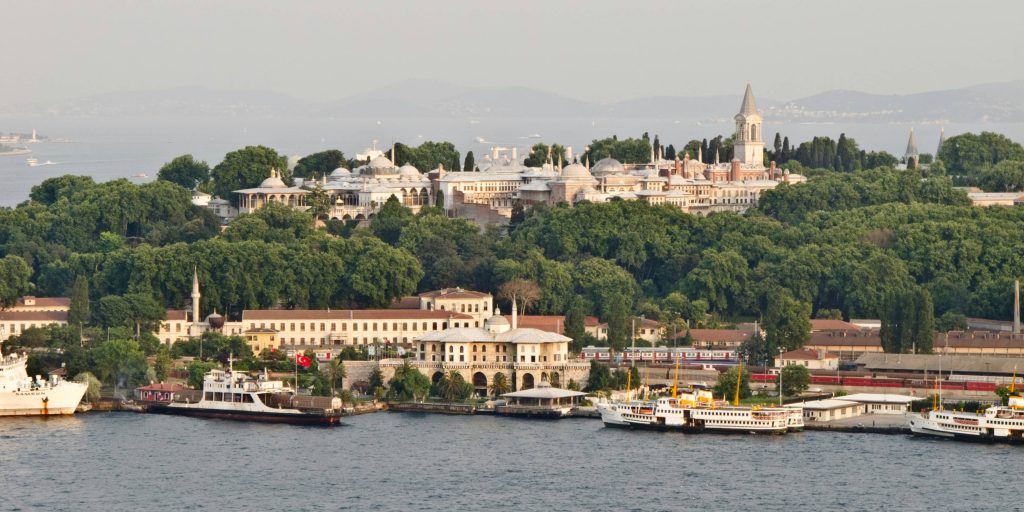
Topkapi Palace in Istanbul served as the main residence of Ottoman sultans for almost 400 years. Today, visitors explore not only a palace but also the decision center of an empire. For this reason, the complex explains how the Ottoman state actually functioned.
History
After conquering Constantinople in 1453, Sultan Mehmed II immediately ordered the construction of the palace. At first, it was relatively small. However, each ruler expanded it.
As a result, Topkapi gradually became a royal city. Here, sultans welcomed ambassadors, announced wars and organized ceremonies. Meanwhile, thousands of officials worked inside the palace every day.
In the 19th century, the court moved to Dolmabahce Palace. Nevertheless, Topkapi remained the symbol of imperial authority.
Courtyards & Layout
The palace consists of four courtyards and each section had a clear function.
First, the public entered the outer courtyard. Next, officials worked in the administrative courtyard. After that, the sultan met guests in the inner courtyard. Finally, only the ruler accessed the private gardens.
Therefore, walking forward meant moving closer to power.
The Harem
Many people believe the Harem was only a private residence. In fact, it functioned as a political center.
For example, the Queen Mother influenced succession decisions. In addition, princes received education here. Because of this, palace politics often started inside the Harem rooms.
Treasury & Sacred Relics
Topkapi holds one of the richest royal collections in the world.
For instance, visitors see the Spoonmaker’s Diamond and the Emerald Dagger. Moreover, the palace preserves sacred relics protected by Ottoman rulers.
Consequently, the treasury shows the real wealth of the empire rather than symbolic decoration.
Visiting Information
Location: Sultanahmet Duration: 2–3 hours Best time: Morning
For the best route, visit after Hagia Sophia. This order follows the historical transition from religion to imperial authority.