Introduction
Located in Demre on the Mediterranean coast of Turkey, Myra was once one of the most important cities of the Lycian civilization. Today visitors see impressive rock-cut tombs and a grand Roman theatre — but Myra was far more than ruins. It was a political capital, a religious center and one of the most artistic cities of Anatolia.
Unlike many ancient cities built only for defense, Myra was designed for life: ceremonies, performances, trade, faith and daily social interaction.

The Lycian Civilization: People Who Challenged Death
The Lycians had a very different belief system from Greeks and Romans.
They believed the soul would rise to the sky after death.
Because of this belief they carved their tombs high into cliffs.
The higher the tomb → the closer to the heavens.
This is why Myra’s necropolis looks like a vertical city for the dead.
Rock-Cut Tombs: Houses for the Afterlife
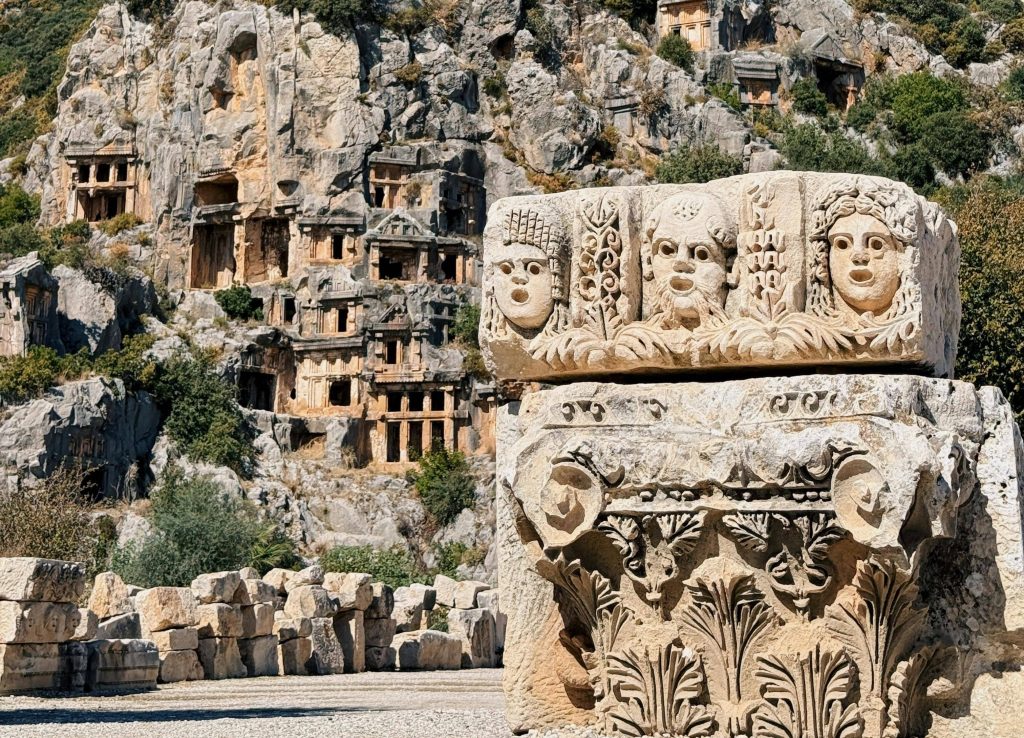
Myra contains some of the best preserved Lycian tombs in the world.
These tombs were not symbolic — they were designed as real houses.
You can see:
wooden beam imitations
door carvings
family symbols
relief figures
The facades copy Lycian wooden architecture which no longer survives anywhere else.
So today, the tombs are the only evidence of how Lycian homes actually looked.
Why they are unique
In many ancient cultures tombs represent death.
In Lycia they represent continuity of life.
The dead did not “leave” — they moved to another home.

Theatre of Myra: Masks, Acoustics and Social Life
The Roman theatre of Myra is one of the largest in southern Anatolia.
Capacity: about 10,000 spectators
But what makes it special are the theatre masks carved into the decoration stones.
The Meaning of the Masks
The masks represent:
comedy
tragedy
daily life characters
The theatre was not just for entertainment — it was the political and social center.
Announcements, public meetings and ceremonies happened here.
Acoustic Perfection
Stand at the stage and whisper — your voice travels to the top rows.
This precision engineering is why Roman theatres were the “media centers” of antiquity.

Myra and St. Nicholas
In the 4th century Myra became the city of Saint Nicholas (Santa Claus).
He was bishop here and known for helping the poor, sailors and children.
Because Myra was a port city (via Andriake harbor), his influence spread across the Mediterranean.
This transformed Myra from a Lycian capital into a Christian pilgrimage destination.

The Harbor of Andriake: Where Trade Made the City Rich
Just 5 km away, Andriake port connected Myra to the Roman world.
Grain warehouses, customs buildings and markets were located here.
The wealth from trade financed:
the theatre
public buildings
monumental tombs
Myra was not isolated — it was an international trade hub.

Why Myra Is Different From Other Ancient Cities
Many ruins show architecture.
Myra shows society.
You see:
beliefs in the tombs
art in the theatre
religion in the church
economy in the harbor
It is a complete urban story.

Visiting Today
Today Myra is part of the Demre region and often visited together with:
St Nicholas Church
Andriake harbor
Kekova sunken city
The site allows visitors to understand Lycian life more clearly than any other city in Turkey.

Final Thought
Myra is not impressive because it is large.
It is impressive because it is human.
The city tells how people lived, performed, traded, worshipped and imagined the afterlife — all in one place.
Walking through Myra is less like visiting ruins and more like entering a preserved civilization.